

By Saurabh Punamiya
Wars teach lessons in resilience economics that are often absent from the conventional wisdom of policymakers. Today, across the Gulf countries, trade routes have become the theater of geopolitics and supply chain risks. Shipping insurance is stoking inflationary pressures. Access to fertilizers and energy goods are matters of national security and sovereignty. One carrier estimates the conflict is adding $40 million to $50 million a week in extra costs once fuel, war-risk premiums, and storage are counted. The Gulf states import 85% of their food, so maritime disruption is a stability risk.
The Strait of Hormuz has long been a critical chokepoint. In 2025, nearly 15 million barrels a day of crude, about 34 percent of global crude oil trade, passed through the waterway, 21 miles (33 kilometers) wide at its narrowest point. China and India together received 44 percent of those exports. Blocking the passage, which Iran had threatened to do many times, would cause a shock that would travel far beyond oil, into credit, inventories, and investment timelines.
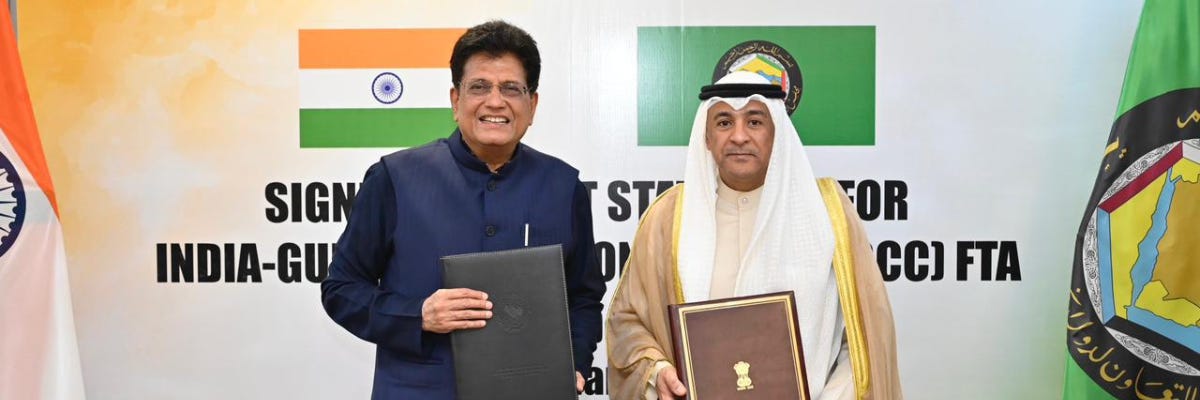
Amid rising U.S.-Iran tensions and concerns about the vulnerability of shipping routes, India and the Gulf Cooperation Council (GCC) formally launched negotiations on a free trade agreement (FTA) on February 24, 2026. The talks signaled a shift toward proactive thinking on how to build institutions to mitigate the next shock, which happened to come four days later with the start of U.S. and Israeli strikes against Iran. The war is a stress test for the India-GCC relationship. It also demonstrates how future shocks will punish over-reliance on a single route.
The corridor has the scale to justify a more ambitious agenda than changing tariff arithmetic. India–GCC trade reached $178.56 billion in FY 2024–25, with exports of $56.87 billion and imports of $121.68 billion, accounting for 15.42% of India’s global trade. Over the last five years, India-GCC trade grew at an annual average of 15.3%. The GCC is a market of about 61.5 million people with GDP around $2.3 trillion. Cumulative GCC investment into India exceeded $31.14 billion by September 2025. The nearly 10 million Indians living in the GCC play a key role in strengthening the bond.
The energy relationship further underscores the strategic exposure. Government data has long noted that GCC countries account for around 35 percent of India’s oil imports and 70 percent of its gas imports. Interdependence at this scale cannot be managed through ad hoc crisis calls. It requires a framework that anticipates risk and rewards investment. The mistake would be to frame this as a story about tariffs. Tariffs are the most visible part of the relationship but not necessarily what will drive it forward. The lack of institutional credibility must be addressed to reach the real prize, an investment cycle that leads to more trade, investment and integration. Call it a Green New Deal for the Arabian Sea, not as a slogan, but as a disciplined pipeline of projects and rules that make decarbonization bankable.
Industrial decarbonization will require engineers, technicians, safety specialists, and project managers moving across grids, hydrogen-ready infrastructure, industrial retrofits, and new production lines.
Start with corridor enablement. More than a line on a map, a corridor is an operating system. The India-GCC talks should put shipping resilience, port readiness, and multimodal redundancy on the agenda, alongside the digital rails that keep trade moving when paperwork becomes a bottleneck. Subsea fibre and trusted documentation standards must be treated as critical economic infrastructure, not technical afterthoughts. That means negotiating the plumbing as seriously as the policy. Contingency routing agreements and common port procedures for priority cargo. Pipelines where they make economic sense, serving as insurance rather than trophies. Subsea power and data cables that make the region faster, more connected and more resilient. Mobility corridors that let project teams move quickly, because projects fail as often from permitting delays as from shortages of capital.
Next, place industrial decarbonization at the center of the growth strategy. Both India and the Gulf will be penalized if their industry remains carbon-intensive and exposed to volatile fuel costs. The transition opportunity clusters into four linked channels: clean electricity cooperation that stabilizes systems; green molecules, such as hydrogen derivatives, that decarbonize fertilizer, refining, and shipping; clean manufacturing supply chains in electrolyzers, power electronics, and grid equipment; and a materials strategy for the critical inputs that set the transition cost curve.
Each channel has its own enabling logic. Electricity needs grid codes, balancing arrangements, and investable models for transmission and storage. Hydrogen derivatives need certification that survives scrutiny and offtake contracts banks will believe. Manufacturing needs long-term finance and standards that protect integrity. Materials need joint approaches to sourcing and processing so electrification does not recreate dependency.
None of this scales if people are treated as an afterthought. The 10 million-strong Indian community in the Gulf is a labor-market interface. Industrial decarbonization will require engineers, technicians, safety specialists, and project managers moving across grids, hydrogen-ready infrastructure, industrial retrofits, and new production lines. Predictable project-linked mobility, qualification recognition, and skill partnerships are productive infrastructure.
If this sounds like a lot to ask of an FTA, that is the point. Trade agreements used to lower transaction costs. Now they must also lower uncertainty. The talks should institutionalize delivery: a resilience and connectivity workstream with a crisis playbook, a standards forum that aligns definitions and credible measurement, and a standing mechanism for business and labor feedback so implementation does not lag behind ambition.
The Gulf’s comparative advantage is balance-sheet capacity while India’s is scale deployment. The negotiations should therefore commit to a climate finance partnership built around three mechanisms: a joint platform that crowds in private capital through co-investment and blended finance; a project preparation facility that makes pipelines bankable and speeds financial close; and a standards and certification forum that makes the word “green” measurable and investable. Judge success by whether sustainable finance flows rise, projects reach financial close faster, and the corridor remains operational under stress. If that happens, the initiation of the 2026 FTA talks will be remembered less as a trade negotiation and more as the moment the region and India decided to shape their interdependence rather than allowing it to be dictated by market forces and shocks.
Saurabh Punamiya is a South and Southeast Asia Policy Council member of the Rihla Initiative for Green Economic Growth. He is a climate-finance and sustainability strategist with eight years of experience working across transport decarbonization, carbon markets, and public-private climate initiatives. He currently works on aligning corporate climate disclosures with emerging policy and investment standards, helping organizations navigate voluntary carbon markets and finance credible emissions reductions.
Section: (rihla-initiative) Photo: GCC Secretariat