

By Vuyiswa Hlongwane
The war that erupted in late February has been analyzed primarily through the lens of Middle Eastern geopolitics. But for Sub-Saharan Africa (SSA), the conflict represents a structural shock arriving through multiple, compounding channels. Understanding its impact on the future of Gulf-Africa relations requires disaggregating the bilateral and multilateral channels carefully, as the effects are neither uniform nor simple.
Before the war, investments in SSA’s climate-related projects were already precarious. The International Monetary Fund’s May 2025 working paper on scaling up climate finance in the region documented a persistent and widening gap between climate investment needs and available resources, compounded by rising debt burdens and constrained fiscal space. The war has accelerated that squeeze.
The World Bank’s April 2026 Africa outlook revised SSA growth down to 4.1% for 2026, unchanged from 2025, but down from the 4.4% forecast in October. The revision was driven directly by the war’s effects: rising fuel and fertilizer costs, disrupted investment flows, and deteriorating external conditions. Debt-servicing costs across the continent had already doubled from 9% of government revenues in 2017 to 18% in 2025. Approximately half of African countries are either at high risk of or already in debt distress.
As the World Bank’s chief economist for Africa stated plainly, “There is very little scope actually for these countries to deal with this crisis because they just don’t have a lot of fiscal space.” For governments already choosing between debt repayment and development spending, a war-induced cost shock does not produce a climate finance trade-off; it eliminates the choice entirely.
The strain is concentrated in oil-importing economies with limited policy room: Burundi, Ethiopia, Kenya, Malawi, and Mozambique face the sharpest exposure. The Strait of Hormuz, through which approximately one-fifth of global oil shipments pass, has remained effectively closed despite the ceasefire announced on 8 April. The US Energy Information Administration has warned that fuel prices could continue rising for months even after the strait reopens. That warning is already being absorbed into transport costs, food prices, and import bills across the continent.
The asymmetry here is noteworthy. SSA’s oil-exporting economies, Angola, Gabon, and Nigeria, receive a short-term fiscal windfall from elevated oil prices. But windfall revenues in commodity-dependent states have a poor track record of being channelled into climate investment, particularly in the absence of the institutional frameworks that Gulf partnerships were beginning to provide. A higher oil price and a weaker Gulf investment pipeline are not a neutral trade-off for the continent’s green transition.
The more consequential long-term risk is the disruption to Gulf climate capital, and this requires understanding how significant that capital had become. Over the preceding three years, Gulf states had emerged as major investors in Africa’s green economy, driven by strategic imperatives around food security, critical minerals access, and sovereign wealth fund diversification into renewable portfolios. At COP28, the UAE pledged $4.5 billion for African clean energy projects.
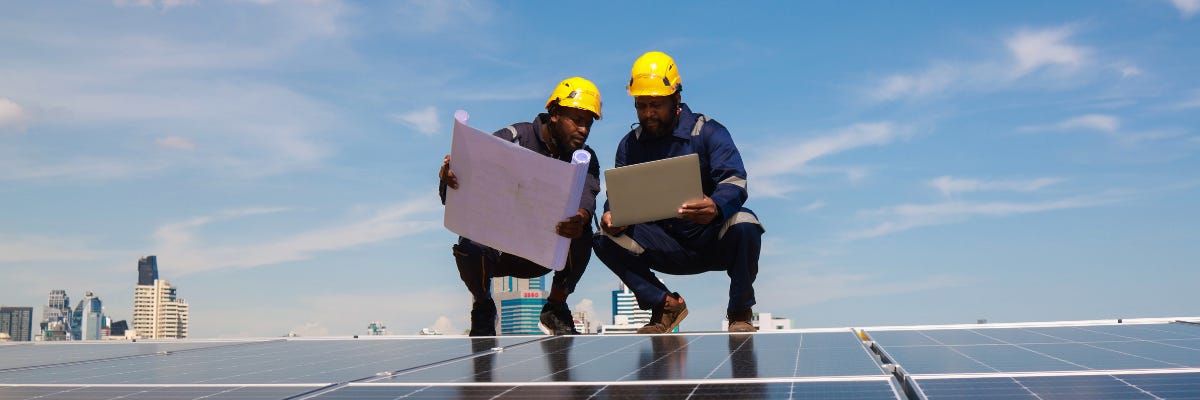
In October 2024, Saudi Arabia pledged approximately $41 billion to SSA infrastructure over the coming decade, including $7 billion already deployed in the renewable energy sector, largely through ACWA Power, which is currently leading Project DAO, South Africa’s largest hybrid renewable plant, valued at $800 million. As recently as August 2025, Qatar’s Al Mansour Holdings announced $103 billion in planned investments across six African countries, spanning mining, energy, and infrastructure.
This was not aid, but strategic capital, structured through blended finance vehicles and public-private partnerships that required stable, long-term planning horizons to close. Now, with Gulf sovereign wealth funds facing domestic war costs, regional instability, and heightened uncertainty, accelerating long-term infrastructure commitments in frontier markets is unclear.
The pipeline of deals that was being negotiated — across East Africa in particular — is now at material risk of delay or withdrawal. Uncertainty alone is enough to stall transactions that require years of relationship-building and regulatory alignment to reach financial close.
A higher oil price and a weaker Gulf investment pipeline are not a neutral trade-off for the continent’s green transition.
A less visible but significant channel runs through labour migration. Millions of African workers are employed across Gulf states, and their remittances function as informal climate resilience funding for household adaptation decisions that formal climate finance does not reach. Ethiopia alone has an estimated 500,000 workers in Saudi Arabia. If prolonged conflict weakens Gulf labour demand or disrupts air connectivity, worker rotations slow, recruitment stalls, and remittance flows contract. The macroeconomic consequences are felt most acutely in the households and rural communities that formal climate adaptation programs have consistently underserved.
Taken together, these channels point to something beyond a temporary disruption. SSA was already facing a structural climate finance gap, running far ahead of what multilateral institutions and Western donors have delivered, and a post-COP political environment in which traditional climate finance commitments were being quietly revised downward. The Gulf was emerging as a credible alternative. Gulf investors were less encumbered by conditionality, motivated by genuine strategic interest, and increasingly organized around the infrastructure that Africa’s green transition actually requires.
That alternative is now suspended at precisely the moment it was beginning to materialize. For a continent that contributes less than 4% of global emissions but bears some of the heaviest costs of climate change, the Gulf crisis represents a development emergency that the standard frameworks of climate finance accountability were not designed to capture. Responding to this crisis demands a more honest reckoning with how fragile the architecture of African climate investment truly is.
Vuyiswa Hlongwane is the Rihla Initiative Regional Coordinator for Sub-Saharan Africa at the Bourse & Bazaar Foundation. She is a sustainability professional deeply committed to fostering green economic growth and sustainable development across Sub-Saharan Africa.
Section: (rihla-initiative) Photo: Narai Chal